Showing posts with label West Java. Show all posts
3
Jaipongan, also known as Jaipong, is a popular traditional dance of Sundanese people, West Java, Indonesia. The dance was created by Gugum Gumbira, based on traditional Sundanese Ketuk Tilu music and Pencak Silat movements.

Jaipongan, also known as jaipong, is a musical performance genre of the Sundanese people in the Sundanese language of West Java, Indonesia. Jaipongan includes revived indigenous arts, like gamelan, but it also did not ignore Western music completely despite the ban on rock and roll. It used its sensuality and the sensuality found in a traditional village music and dance, ketuk tilu. However, many believe it is something purely Indonesian or Sundanese in origin and style. It is developed predominately from rural folk forms and traditions as a purely indigenous form. The rise of cassettes and films has led to the popularity of the musical form of jaipongan. It has spread from its home in West Java’s Sunda, to greater Java and Indonesia. It can be seen as many regional varieties of gong-chime performance found through much of Indonesia. As also an urban dance form, it is based primarily on the village forms of ketuk tilu and on the Indonesian martial arts, pencak silat. The musical genre is largely influenced from ketuk tilu with traces of the masked theater dance, topeng banjet and the wayang golek puppet theater. Ketuk tilu is its biggest influence, as a traditional Sudanese musical entertainment form.

Gong-chime performance is characterized by such features as: use of an ensemble dominated by idiophones, metallophones and knobbed gongs. It is a stratified polyphony, with lower-pitch instruments playing parts of lesser density and all parts are structured colotomically around time-cycles. This can be found in traditional Indonesian gamelan. There is improvisation on certain instruments. The modes used are grouped into two broad types: slendro and pelog.

Ketuk tilu was a musical genre based off ritual and celebration in the villages of the Sundanese people, meaning three kettle gongs. It was known for complex drumming coordinated with equally dynamic solo female dancers. The music was performed for planting and harvesting rituals and later celebrated village life, circumcision and marriage, expressed fertility, and displayed sensuality, eroticism and even sometimes “socially accepted prostitution.” Ketuk tilu was very popular in the Sundanese villages, but the urban Sundanese considered it unrefined and inappropriate because the music involved males and females dancing together suggestively, or mixed dancing between men and ronggeng, or prostitutes. Ronggeng probably has existed in Java since ancient time, the bas reliefs in Karmawibhanga section on Borobudur displays the scene of travelling entertainment troupe with musicians and female dancers.

Jaipong is less strictly associated with ceremonial functions, but performances are common in the Rayagung festival month, and with circumcisions and marriages. The performances now have the character of secular social functions, attended by young and old, primarily for entertainment and socializing. Public performance is now extremely frequent especially in clubs or street performances.

The cassette industry and its boom in Indonesia helped popularize jaipongan greatly and promoted regional styles rather than hurt them. Many learned the dance through cassette rather than the performance. The mass media have made jaipong ubiquitous. It has created competition in the styles of the drummers among ensembles. It has also helped to bring about many dance schools, altering dance and its label on females in West Java.

The song repertoire of jaipongan is varied, and that is why it is better understood as an intertwined performance style of music and dance. Many songs are associated with ketuk tilu or other wide reaching regional varieties, not traditional gamelan. It consists of songs of more recent origin often composed for jaipongan. Song topics vary, encompassing amatory, moralistic, bawdy, topical and spiritual subjects, often emphasizing grass roots culture.
1
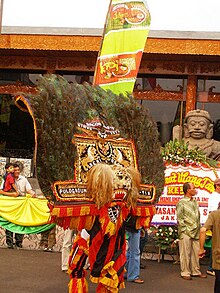
Reog is a traditional Indonesian dance form. There are many types of Reogs in Indonesia, but the most notable ones are Reog Ponorogo (East Java) and Reog Sunda (West Java). Although both share a similar name, there is no connection nor similar theme among these traditions. Reog Ponorogo seems to be the kind of dance that demonstrate physical strength and extravagant lion-peafowl mask and costumes, while Reog Sunda is a lot more like a traditional musical comedy and dance.

Reog is a traditional dance that become the main identity for Ponorogo Regency. Reog National Festival is held every years along the anniversary of Ponorogo regency and Grebeg Suro celebration. Reog dance is also staged full moon nightly in paseban, Ponorogo town square. Reog told about the struggle for a prince who will propose to a beautiful princess. Reog Ponorogo tells the story of a mythical battle between the King of Ponorogo and the magical lion-like creature called Singa Barong. Singa Barong is a large mask usually made of tiger's or leopard's head skin, upon the mask attached a large fan adorned with peafowl feathers. The Singa Barong mask was notoriously heavy, the dancer of Singo Barong bear the mask about 30 – 40 kg weight and supported by the strength of their teeth.

The leading figures in Reog Ponorogo performance includes:

  • Klono Sewandono, A men in regal attire wearing mask in proud and pompous dance, play the role as the King of Ponorogo
  • Bujang Anom, rough youthful men wearing red mask, they performed acrobatic dances and sometimes also involved trance.
  • Jatil, the youthful handsome horsemen riding horses made of weaved bamboo, similar to Kuda Lumping dance. Today Jatil usually performed by female dancers.
  • Warok, played as Singa Barong, the mythical creature. The one that allowed to performed this mask dance is called warok. A warok is the hororary title of local hero or strongman of the village that possessed both exceptional spiritual and phyisical strength. The dance itself is demonstration of phyisical strength of the dancers.

Reog Ponorogo usually consists of three sets of dances; each dance is performed by several dancers:

  • The first dance is the opening dance, performed by Bujang Anom, male dancers wearing black costumes. The costume describe rough men with intimidating moustache and other masculinity symbols.
  • The second dance is the Jaran Kepang dance performed by Jatil; it is originally performed by a gemblak, a handsome and youthful teenage boy wearing colourful costumes. Today the female dancers were usually played this role.
  • The third dance is the main attraction of the show; it is performed by all the Reog dancers. The warok as the main male dancer, wearing a large and heavy lion mask, dances in the centre of the stage while the other dancers dance around him. To demonstrate the warok's extraordinary strength Jatil or female dancers riding on top of lion mask and being carried around.

Culture and traditions of Reog Ponorogo

The dance describe Klono Sewandono the king of Ponorogo on his journey to Kediri to seek the hands of Princess Songgo Langit. On his journey he was attacked by a vicious monster called Singa Barong, a mythical lion with peacock on its head. Historians trace the origin of Reog Ponorogo as the satire on the incompetence of Majapahit rulers during the end of the empire. It describe the innate Ponorogo liberty and its opposition on centralist Majapahit rule. The lion represent the king of Majapahit while the peafowl represent the queen, it was suggested that the king was incompetent and always being controlled by his queen. The beautiful, youthful and almost effeminate horsemen describe the Majapahit cavalry that have lost their manliness.

Reog Sunda is very different than Ponorogo one, reog Sunda did not incorporate a large lion mask adorned with peafowl feathers like Reog Ponorogo, and did not incorporate trance state. The Reog Sunda performance combines comedy, joke, music, and funny comical movements and dances of the performers. The performers usually consist of four personnel, one called dalang directing the shows, similar to dalang in wayang performance, one called wakil or vice-dalang, the other two were the performers that interact and do the order of the dalang. Each performers carying and using musical instruments such as dogdog, beungbreung, gudubrag (types of traditional drums), and kecrek (similar to maraca) or tambourine, other instruments such as kendang, gong, kacapi might also used. The performance usually took one hour to one and half hour of music, dance and jokes, filled with social messages or religious wisdom.
1

Wayang golek is a traditional form of puppetry from Sunda. Unlike the better-known leather shadow puppets (wayang kulit) found in the rest of Java and Bali, wayang golek puppets are made from wood and are three-dimensional, rather than two. They use a banana palm in which the puppets stand, behind which one puppeteer (dalang) is accompanied by his gamelan orchestra with up to 20 musicians. The gamelan uses a five-note scale as opposed to the seven-note western scale. The musicians are guided by the drummer, who in turn is guided by signals from the puppet master dalang gives to change the mood or pace required. Wayang golek are used by the Sundanese to tell the epic play "Mahabarata" and various other morality type plays.
0
The three main types of Sundanese bamboo ensembles are angklung, calung, and arumba. The exact features of each ensemble vary according to context, related instruments, and relative popularity.
Angklung with eight pitches

Angklung is a generic term for sets of tuned, shaken bamboo rattles. Angklung consists of a frame upon which hang several different lengths of hollow bamboo. Angklungs are played like handbells, with each instrument played to a different note. Angklung rattles are played in interlocking patterns, usually with only one or two instruments played per person. The ensemble is used in Sundanese processions, sometimes with trance or acrobatics. Performed at life-cycle rituals and feasts (hajat), angklung is believed to maintain balance and harmony in the village. In its most modern incarnation, angklung is performed in schools as an aid to learning about music.

The Angklung got more international attention when Daeng Soetigna, from Bandung, West Java, expanded the angklung notations not only to play traditional pélog or sléndro scales, but also diatonic scale in 1938. Since then, angklung is often played together with other western music instruments in an orchestra. One of the first well-known performances of angklung in an orchestra was during the Bandung Conference in 1955.

Like those in angklung, the instruments of the calung ensemble are of bamboo, but each consists of several differently tuned tubes fixed onto a piece of bamboo; the player holds the instrument in his left hand and strikes it with a beater held in his right. The highest-pitched calung has the greatest number of tubes and the densest musical activity; the lowest-pitched, with two tubes, has the least. Calung is nearly always associated with earthy humor, and is played by men.

Arumba refers to a set of diatonically tuned bamboo xylophones, often played by women. It is frequently joined by modern instruments, including a drum set, electric guitar, bass, and keyboards.
0
Gamelan orchestra

The musical arts of Sunda, which is an expression of the emotions of Sundanese culture, express politeness and grace of Sundanese. The music is claimed to be some of the most beautiful sounds in the world. Degung orchestra consists of Sundanese gamelan.

In addition to the Sundanese forms of Gamelan in Parahyangan, the region of Cirebon retains its own distinct musical traditions. Amongst Cirebons' varying Gamelan ensembles the two most frequently heard are Gamelan Pelog (a non-equidistant heptatonic tuning system) and Gamelan Prawa (a semi-equidistant pentatonic tuning system). Gamelan Pelog is traditionally reserved for Tayuban, Wayang Cepak, and for listening and dance music of the Kratons in Cirebon. Whereas Gamelan Prawa is traditionally reserved for Wayang Purwa.

Cirebon also retains specialized Gamelan ensembles including: Sekaten, which is played in the Kratons to mark important times in the Islamic calendar. Denggung, also a Kraton ensemble which is believed to have a number of "supernatural powers". And Renteng, an ensemble found in both Cirebon and Parahyangan that is known for its loud and energetic playing style.
0
The oldest human inhabitant archaeological findings in the region were unearthed in Anyer (the western coast of Java) with evidence of bronze and iron metallurgical culture dating to the first millennium AD. The prehistoric Buni (near present-day Bekasi) clay pottery were later developed with evidence found in Anyer to Cirebon. Artefacts (dated from 400 BC - AD 100) such as food and drink containers were found mostly as burial gifts. There is also archeological evidence in Batujaya Archaeological Site dating from the 2nd century,[citation needed] and according to Dr Tony Djubiantono, the head of Bandung Archeology Agency, Jiwa Temple in Batujaya, Karawang, West Java was also built around this time.

The earliest known recorded history is from the former Tarumanagara kingdom where seven fourth century stones are inscribed in Wengi letters (used in the Indian Pallava period) and in Sanskrit describing the kings of the kingdom Tarumanagara. Records of Tarumanegara's administration lasted until the sixth century, which coincides with the attack of Srivijaya as stated in the Kota Kapur inscription (AD 686).

The Sunda kingdom subsequently became the ruling power of the region, as recorded on the Kebon Kopi II inscription (AD 932).

An Ulama, Sunan Gunung Jati, settled in Banten Girang, with the intention of spreading the world of Islam in the pagan town. In the meantime, the Sultanate of Demak in central Java grew to an immediate threat against the Sunda kingdom. To defend against the threat, Prabu Surawisesa Jayaperkosa signed a treaty (known as the Luso Sundanese Treaty) with the Portuguese in 1512. In return, the Portuguese was granted an accession to build fortresses and warehouses in the area, as well as trading agreement with the kingdom. This first international treaty of West Java with the Europeans was commemorated by the placement of the Padrao stone monument at the riverbank of the Ciliwung River in 1522.

Although the treaty with Portuguese had been established, it could not come to realization. Sunda Kalapa harbour fell under the alliance of the Sultanate of Demak and the Sultanate of Cirebon (former vassal state of Sunda kingdom) in 1524 after their troops under Paletehan alias Fadillah Khan had conquered the city. In 1524/1525, their troops under Sunan Gunung Jati also seized the port of Banten and established the Sultanate of Banten which was affiliating with the Sultanate of Demak. The war between the Sunda kingdom with Demak and Cirebon sultanates then continued for five years until a peace treaty were made in 1531 between King Surawisesa and Sunan Gunung Jati. From 1567 to 1579, under the last king Raja Mulya, alias Prabu Surya Kencana, Sunda kingdom declined essentially under the pressure from the Sultanate of Banten. After 1576, the kingdom could not maintain its capital at Pakuan Pajajaran (the present-day Bogor) and gradually the Sultanate of Banten took over the former Sunda kingdom's region. The Mataram Sultanate from central Java also seized the Priangan region, the southeastern part of the kingdom.

In the sixteenth century, the Dutch and the British trading companies established their trading ships in West Java after the falldown of Sultanate of Banten. For the next three hundred years, West Java fell under the Dutch East Indies' administration. West Java was officially declared as a province of Indonesia in 1950, referring to a statement from Staatblad number 378. On October 17, 2000, as part of nationwide political decentralization, Banten was separated from West Java and made into a new province. There have been recent proposals to rename the province Pasundan ("Province of the Sundanese") after the historical name for West Java.
0
Sumatran tiger (Panthera tigris sumatrae) is a subspecies of tiger found on the Indonesian island of Sumatra. Recent genetic testing has revealed the presence of unique genetic markers, which isolate Sumatran tigers from all mainland subspecies. About 400-500 wild Sumatran tigers were believed to exist in 1998, but their numbers have continued to decline. According to the RSPB in March 2008 there were approximately 300 Sumatran Tigers remaining in the wild.

The origin of fauna in Indonesia is heavily affected by geographical and geological events on the Asian continental landmass and the Australasian continental landmass (now Australia). The present New Guinea island was connected with the present Australia continent, forming a supercontinent called the southern supercontinent Gondwana. This supercontinent began to break up 140 million years ago, and the New Guinea region (previously known as Sahul) moved towards the equator. As a result, animals from New Guinea traveled to the Australian continent and vice versa, creating many different species living in different ecosystems. This activities continued to occur until the two regions separated completely.

The influence of the Asian continental landmass, on the other hand, was the result of the reformation of the Laurasia supercontinent, which existed after the breakup of Rodinia around 1 billion years ago. Around 200 million years ago, the Laurasia supercontinent split completely, forming Laurentia (now America) and Eurasia continents. The mainland of the Eurasia continent, including China, was not separated completely from the Indonesian archipelago. As a result, animals from the Eurasia mainland could travel to the archipelago, and, under a different ecosystems, new forms of species were formed.

In the nineteenth century, Alfred Russel Wallace proposed the idea of the Wallace Line, a notional line dividing the Indonesian archipelago into two regions, the Asian zoogeographical region (Sundaland) and the Australasian zoogeographical region (Wallacea). The line runs through the Malay Archipelago, between Borneo and Sulawesi (Celebes); and between Bali and Lombok. Although the distance from Bali to Lombok is relatively short, only about 35 kilometres, the fauna distribution is still affected by the line. For example, a group of birds would refuse to cross even the smallest stretches of open water. A second line, lying east, known as the Webber Line, has also been proposed to separate between "transition species" and species of Australian origin.