Showing posts with label Fauna of Indonesia. Show all posts
0
The Komodo dragon (Varanus komodoensis) is a large species of lizard found in the Indonesian islands of Komodo, Rinca, Flores, Gili Motang and Gili Dasami. A member of the monitor lizard family (Varanidae), it is the largest living species of lizard, growing to a maximum of length 3 metres (9.8 ft) in rare cases and weighing up to around 70 kilograms (150 lb). Their unusual size has been attributed to island gigantism, since there are no other carnivorous animals to fill the niche on the islands where they live.

However, recent research suggests that the large size of komodo dragons may be better understood as representative of a relict population of very large varanid lizards that once lived across Indonesia and Australia, most of which, along with other megafauna, died out after the Pleistocene. Fossils very similar to V. komodoensis have been found in Australia dating to greater than 3.8 million years ago, and its body size remained stable on Flores, one of the handful of Indonesian islands where it is currently found, over the last 900,000 years, "a time marked by major faunal turnovers, extinction of the island's megafauna, and the arrival of early hominids by 880 ka." and scientists believe they share an ancestry with the cretacious period man eating predator.

As a result of their size, these lizards dominate the ecosystems in which they live. Komodo dragons hunt and ambush prey including invertebrates, birds, and mammals. Their group behaviour in hunting is exceptional in the reptile world. The diet of big Komodo dragons mainly consists of deer, though they also eat considerable amounts of carrion.

Mating begins between May and August, and the eggs are laid in September. About twenty eggs are deposited in abandoned megapode nests or in a self-dug nesting hole. The eggs are incubated for seven to eight months, hatching in April, when insects are most plentiful. Young Komodo dragons are vulnerable and therefore dwell in trees, safe from predators and cannibalistic adults. They take about eight to nine years to mature, and are estimated to live for up to 30 years.

Komodo dragons were first recorded by Western scientists in 1910. Their large size and fearsome reputation make them popular zoo exhibits. In the wild their range has contracted due to human activities and they are listed as vulnerable by the IUCN. They are protected under Indonesian law, and a national park, Komodo National Park, was founded to aid protection efforts.
2
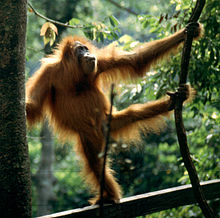
The Sumatran orangutan (Pongo abelii) is one of the two species of orangutans. Found only on the island of Sumatra, in Indonesia, it is rarer and smaller than the Bornean orangutan. The Sumatran orangutan grows to about 1.4 metres (4.6 ft) tall and 90 kilograms (200 lb) in males. Females are smaller, averaging 90 centimetres (3.0 ft) and 45 kilograms (99 lb).

Compared with the Bornean orangutan, the Sumatran orangutan tends to be more frugivorous and especially insectivorous. Preferred fruits include figs and jackfruits. It will also eat bird eggs and small vertebrates. Sumatran orangutans spend far less time feeding on the inner bark of trees.

Wild Sumatran orangutans in the Suaq Balimbing swamp have been observed using tools. An orangutan will break off a tree branch that is about a foot long, snap off the twigs and fray one end. It then will use the stick to dig in tree holes for termites. They will also use the stick to poke a bee's nest wall, move it around and catch the honey. In addition, orangutans use tools to eat fruit. When the fruit of the Neesia tree ripens, its hard, ridged husk softens until it falls open. Inside are seeds that the orangutans enjoy eating, but they are surrounded by fiberglass-like hairs that are painful if eaten. A Neesia-eating orangutan will select a five-inch stick, strip off its bark, and then carefully collect the hairs with it. Once the fruit is safe, the ape will eat the seeds using the stick or its fingers. Although similar swamps can be found in Borneo, wild Bornean orangutans have not been seen using these types of tools.

NHNZ filmed the Sumatran orangutan for its show Wild Asia: In the Realm of the Red Ape; it showed one of them using a simple tool, a twig, to pry food from difficult places. There is also a sequence of an animal using a large leaf as an umbrella in a tropical rainstorm.

The Sumatran orangutan is also more arboreal than its Bornean cousin; this could be because of the presence of large predators like the Sumatran Tiger. It moves through the trees by brachiation.
Life cycle

The Sumatran orangutan is more social than its Bornean counterpart. Groups of these orangutans gather to feed on the mass amount of fruiting on the fig trees. However adult males generally avoid contact with other adult males. Sub-adult males will try to mate with any female, though they probably mostly fail to impregnate them since mature females are easily capable of fending them off. Mature females prefer to mate with mature males.

The average interbirth rates for the Sumatran orangutan is 9.3 years – the longest reported among the great apes, including the Bornean orangutan. Infant orangutans will stay close to their mother for up to three years. Even after that, the young will still associate with their mother. Both orangutan species are likely to live several decades; estimated longevity is more than 50 years. The average of the first reproduction of P. abelii is around 15.4 years old. There is no indication of menopause.

The Sumatran orangutan is endemic to Sumatra island and is particularly restricted to the north of the island. In the wild, Sumatran orangutans survive in the province of Nanggroe Aceh Darussalam (NAD), the northernmost tip of Sumatra. The primate was once more widespread, as they were found more to the south in the 19th century such as in Jambi and Padang. There are small populations in the North Sumatra province along the border with NAD, particularly in the Lake Toba forests. A survey in the Lake Toba region found only two inhabited areas, Bukit Lawang (defined as the animal sanctuary) and Gunung Leuser National Park. The species has been assessed as critically endangered on the IUCN Red List since 2000. It is considered one of "The World's 25 Most Endangered Primates."

A survey in 2004 estimated that around 7,300 Sumatran orangutans still live in the wild. Some of them are being protected in five areas in Gunung Leuser National Park; others live in unprotected areas: northwest and northeast Aceh block, West Batang Toru river, East Sarulla and Sidiangkat. A successful breeding program has been established in Bukit Tiga Puluh National Park in Jambi and Riau provinces.

Nonja, thought to be the world's oldest in captivity or the wild at the time of her death, died at the Miami MetroZoo at the age of 55.
0
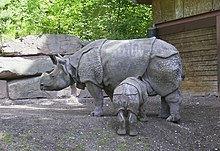
The Javan Rhinoceros (Sunda Rhinoceros to be more precise) or Lesser One-horned Rhinoceros (Rhinoceros sondaicus) is a member of the family Rhinocerotidae and one of five extant rhinoceroses. It belongs to the same genus as the Indian Rhinoceros, and has similar mosaicked skin which resembles armor, but at 3.1–3.2 m (10–10.5 feet) in length and 1.4–1.7 m (4.6–5.8 ft) in height, it is smaller than the Indian Rhinoceros, and is closer in size to the Black Rhinoceros. Its horn is usually less than 25 cm (10 inches), smaller than those of the other rhino species.

Once the most widespread of Asian rhinoceroses, the Javan Rhinoceros ranged from the islands of Indonesia, throughout Southeast Asia, and into India and China. The species is now critically endangered, with only two known populations in the wild, and none in zoos. It is possibly the rarest large mammal on earth. A population of as few as 40 live in Ujung Kulon National Park on the island of Java in Indonesia and a small population, estimated in 2007 to be no more than eight, survives in Cat Tien National Park in Vietnam. The decline of the Javan Rhinoceros is attributed to poaching, primarily for their horns, which are highly valued in traditional Chinese medicine, fetching as much as $30,000 per kilogram on the black market. Loss of habitat, especially as the result of wars, such as the Vietnam War, in Southeast Asia, has also contributed to the species's decline and hindered recovery. The remaining range is only within two nationally protected areas, but the rhinos are still at risk from poachers, disease and loss of genetic diversity leading to inbreeding depression. None are held in captivity.

The Javan Rhino can live approximately 30–45 years in the wild. It historically inhabited lowland rain forest, wet grasslands and large floodplains. The Javan Rhino is mostly solitary, except for courtship and child-rearing, though groups may occasionally congregate near wallows and salt licks. Aside from humans, adults have no predators in their range. The Javan Rhino usually avoids humans, but will attack when it feels threatened. Scientists and conservationists rarely study the animals directly due to their extreme rarity and the danger of interfering with such an endangered species. Researchers rely on camera traps and fecal samples to gauge health and behavior. Consequently, the Javan Rhino is the least studied of all rhino species. On February 28, 2011, a video was released by WWF and Indonesia's National Park Authority which captured two rhinos with their calves. This motion triggered video proved that these animals are still breeding in the wild.
0
Sumatran tiger (Panthera tigris sumatrae) is a subspecies of tiger found on the Indonesian island of Sumatra. Recent genetic testing has revealed the presence of unique genetic markers, which isolate Sumatran tigers from all mainland subspecies. About 400-500 wild Sumatran tigers were believed to exist in 1998, but their numbers have continued to decline. According to the RSPB in March 2008 there were approximately 300 Sumatran Tigers remaining in the wild.

The origin of fauna in Indonesia is heavily affected by geographical and geological events on the Asian continental landmass and the Australasian continental landmass (now Australia). The present New Guinea island was connected with the present Australia continent, forming a supercontinent called the southern supercontinent Gondwana. This supercontinent began to break up 140 million years ago, and the New Guinea region (previously known as Sahul) moved towards the equator. As a result, animals from New Guinea traveled to the Australian continent and vice versa, creating many different species living in different ecosystems. This activities continued to occur until the two regions separated completely.

The influence of the Asian continental landmass, on the other hand, was the result of the reformation of the Laurasia supercontinent, which existed after the breakup of Rodinia around 1 billion years ago. Around 200 million years ago, the Laurasia supercontinent split completely, forming Laurentia (now America) and Eurasia continents. The mainland of the Eurasia continent, including China, was not separated completely from the Indonesian archipelago. As a result, animals from the Eurasia mainland could travel to the archipelago, and, under a different ecosystems, new forms of species were formed.

In the nineteenth century, Alfred Russel Wallace proposed the idea of the Wallace Line, a notional line dividing the Indonesian archipelago into two regions, the Asian zoogeographical region (Sundaland) and the Australasian zoogeographical region (Wallacea). The line runs through the Malay Archipelago, between Borneo and Sulawesi (Celebes); and between Bali and Lombok. Although the distance from Bali to Lombok is relatively short, only about 35 kilometres, the fauna distribution is still affected by the line. For example, a group of birds would refuse to cross even the smallest stretches of open water. A second line, lying east, known as the Webber Line, has also been proposed to separate between "transition species" and species of Australian origin.